
Cation Resin vs Anion Resin
Water treatment industries widely use ion exchange resins for purification, demineralization, and water softening processes. Understanding Cation Resin vs Anion Resin is important for selecting the right resin for industrial and commercial water treatment systems. Both resins play a vital role in removing unwanted ions from water and improving water quality.
At Hanumanta Watertech, we provide high-quality ion exchange resin solutions for water softening plants, DM plants, and industrial water purification systems.
What is Cation Resin?
Cation resin is an ion exchange resin that removes positively charged ions from water. These ions mainly include:
- Calcium (Ca²⁺)
- Magnesium (Mg²⁺)
- Sodium (Na⁺)
- Iron (Fe²⁺)
Cation exchange resin is mainly used in:
- Water softening systems
- Demineralization plants
- Boiler feed water treatment
- Industrial water purification
Working Process of Cation Resin
Cation resin exchanges hydrogen (H⁺) or sodium (Na⁺) ions with hardness-causing ions present in water. This process helps in reducing water hardness and improving water quality.
What is Anion Resin?
Anion resin removes negatively charged ions from water such as:
- Chloride (Cl⁻)
- Sulfate (SO₄²⁻)
- Nitrate (NO₃⁻)
- Silica (SiO₂)
Anion exchange resin is commonly used in:
- DM water plants
- RO polishing systems
- Pharmaceutical industries
- Chemical processing industries
Working Process of Anion Resin
Anion resin exchanges hydroxide ions (OH⁻) with negatively charged contaminants in water. This process helps in producing highly purified water.
Cation Resin vs Anion Resin: Key Differences
| Feature | Cation Resin | Anion Resin |
|---|---|---|
| Removes | Positive ions | Negative ions |
| Exchange Ion | H⁺ or Na⁺ | OH⁻ |
| Main Function | Water softening | Demineralization |
| Common Use | Softener plants | DM plants |
| Regeneration Chemical | Acid | Caustic soda |
| Ion Type Removed | Calcium, Magnesium | Chloride, Sulfate |
| Application | Hardness removal | Purification |
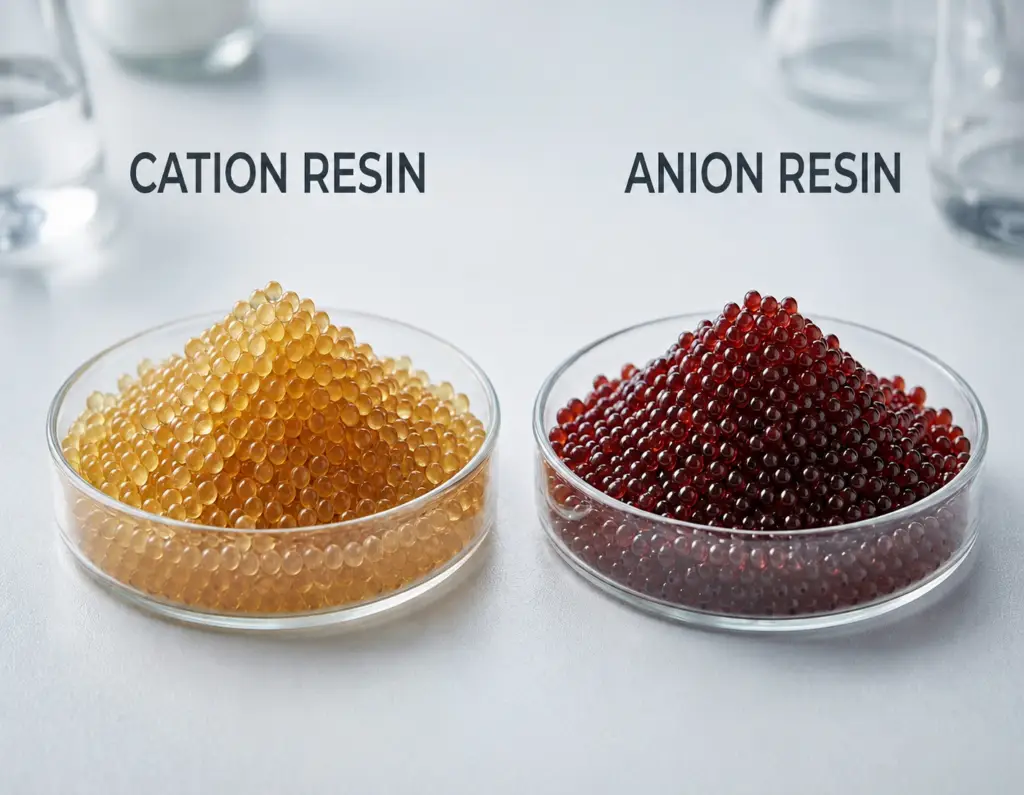
Types of Cation and Anion Resin
Types of Cation Resin
- Strong Acid Cation Resin
- Weak Acid Cation Resin
Types of Anion Resin
- Strong Base Anion Resin
- Weak Base Anion Resin
Applications of Cation Resin vs Anion Resin
Applications of Cation Resin
- Industrial water softening
- Textile industry
- Power plants
- Food processing industry
- Boiler water treatment
Applications of Anion Resin
- Demineralized water production
- Pharmaceutical manufacturing
- Electronics industry
- Chemical processing
- RO plant polishing
Advantages of Cation Resin vs Anion Resin
Benefits of Cation Resin
- Removes water hardness effectively
- Improves equipment life
- Reduces scale formation
- Enhances boiler efficiency
Benefits of Anion Resin
- Produces high-purity water
- Removes harmful anions
- Improves water conductivity
- Supports industrial purification
How to Choose Between Cation Resin vs Anion Resin
Choosing the right resin depends on:
- Water quality
- Industrial application
- TDS level
- Hardness level
- Purity requirements
In most industrial water treatment systems, both cation and anion resins are used together for complete demineralization.
Why Choose Hanumanta Watertech?
Hanumanta Watertech offers reliable ion exchange resin solutions for multiple industries. We provide:
- Premium quality resin
- Industrial water treatment solutions
- Water softening plant support
- Technical consultation
- Customized resin solutions
You can also explore our:
Conclusion
Understanding Cation Resin vs Anion Resin is essential for selecting the right water treatment solution. Cation resin removes positively charged ions responsible for water hardness, while anion resin removes negatively charged impurities for high-purity water production.
Both resins are important components in industrial water treatment, DM plants, and water softening systems. Choosing the correct resin can improve efficiency, reduce maintenance costs, and ensure better water quality.
Hanumanta Watertech provides advanced ion exchange resin solutions designed for efficient industrial water treatment applications.
Contact Details
- Company Name: Hanumanta Watertech Pvt. Ltd.
- Email: sales@hanumantawatertech.com
- Official Email: hanumantawatertech@gmail.com
- Mo :
- Location: Shop No. TF-07, Plot No. 1411, Global Trade Center, GIDC,
Ankleshwar – 393 002, Gujarat, India
1. What is the main difference between cation resin and anion resin?
Cation resin removes positively charged ions, while anion resin removes negatively charged ions from water.
2. Where is cation resin used?
Cation resin is mainly used in water softening plants and boiler feed water treatment.
3. What is anion resin used for?
Anion resin is used for demineralization and high-purity water treatment applications.
4. Can cation and anion resin work together?
Yes, both resins are commonly used together in DM plants for complete water purification.
5. Which resin removes hardness from water?
Cation exchange resin removes hardness-causing ions like calcium and magnesium.
Pingback: How to Regenerate Ion Exchange Resin: 7 Easy Steps (Step-by-Step Guide) - Hanumanta Water Tech