
How to Regenerate Ion Exchange Resin: 7 Easy Steps (Step-by-Step Guide)
Learning how to regenerate ion exchange resin is one of the most valuable skills for anyone running a DM plant, water softener, or industrial water treatment system. Over time, the active sites on the resin beads fill up with the ions they have removed, and the resin stops working. Regeneration restores those active sites so the resin can be used again — saving you the cost of buying new resin every few months.
In this step-by-step guide, you will learn exactly how to regenerate ion exchange resin safely and effectively, which chemicals to use for cation and anion resin, the correct dosing, and the common mistakes that quietly shorten resin life.
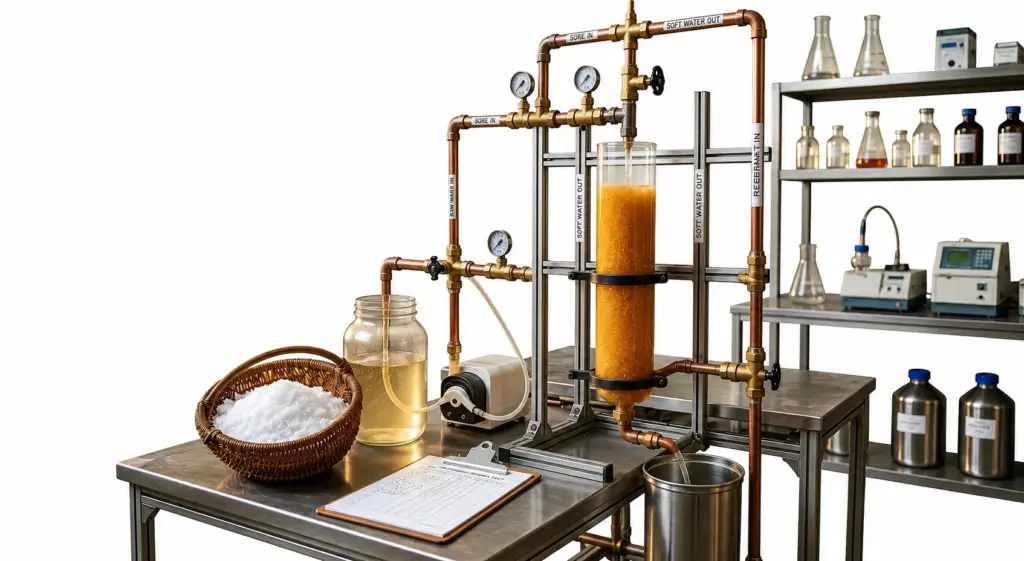
How to Regenerate Ion Exchange Resin
What Does It Mean to Regenerate Ion Exchange Resin?
Ion exchange resin works by swapping unwanted ions in water for harmless ones held on the resin beads. A cation resin, for example, trades hydrogen or sodium ions for hardness-causing calcium and magnesium.
Eventually every exchange site is occupied and the resin becomes “exhausted.” At that point the output water quality drops sharply. Regeneration is simply the process of flushing the resin with a strong chemical solution that reverses the exchange, pushing out the captured ions and recharging the beads.
The underlying chemistry is the same ion exchange reaction running in reverse. Done correctly, a single batch of resin can be regenerated hundreds of times before it needs replacing.
Why Resin Regeneration Matters?
Skipping or delaying regeneration is one of the most expensive mistakes in water treatment. Exhausted resin lets hardness, salts, or organics slip through, which can scale boilers, foul membranes, and ruin product quality downstream.
Proper regeneration keeps your treated water within spec, protects expensive equipment, and dramatically lowers operating cost. Resin is a significant capital item, so a good regeneration routine that extends its life directly improves your bottom line.
It also keeps your plant compliant. Many industries — pharmaceuticals, power, and food processing among them — have strict water-quality limits that only well-maintained resin can meet.
Cation vs Anion Resin: Different Regeneration Chemicals
Before how regenerate ion exchange resin, you need to know which type you are working with, because the chemicals are completely different. Using the wrong one will damage the resin.
Regenerating Cation Resin
Strong acid cation (SAC) resin is regenerated with an acid — usually hydrochloric acid (HCl) or sulphuric acid (H₂SO₄). The acid supplies hydrogen ions that displace the calcium, magnesium, and sodium the resin has captured.
If you are softening water, sodium-form cation resin is instead regenerated with a simple brine (sodium chloride) solution, which is why a water softener uses salt. You can read more about this in our guide on Cation Resin vs Anion Resin.
Regenerating Anion Resin
Strong base anion (SBA) resin is regenerated with a caustic solution — typically sodium hydroxide (NaOH). The hydroxide ions displace the captured anions such as chlorides, sulphates, and silica.
Always regenerate anion resin with caustic only, and store your acid and caustic well apart. For the full resin range and the right regenerant for each grade, how to regenerate ion exchange resin see our Ion Exchange Resins (IONIC-RESIN™)page.
Safety Precautions Before You Start
Regeneration uses strong acids and caustic, so safety comes first. Always wear chemical-resistant gloves, goggles, and an apron, and work in a well-ventilated area.
Keep an eye wash station and a clean water supply within reach in case of accidental contact. Store acid and caustic in clearly labelled, separate containers, and never mix them — combining the two releases dangerous heat.
Confirm your dilution water is clean and free of chlorine, which can oxidise and permanently damage the resin. A few minutes of preparation here prevents both injuries and ruined resin batches.
How to Regenerate Ion Exchange Resin in 7 Steps
Here is the complete, easy-to-follow process of how to regenerate ion exchange resin – The same seven steps apply to both cation and anion resin — only the regenerant chemical changes.
Step 1: Backwash the Resin Bed
Run clean water upward through the bed to loosen and expand the resin. This removes trapped dirt, broken beads, and any compacted layers. Backwash for 10–15 minutes until the outflow runs clear.
Step 2: Prepare the Regenerant Solution
Mix your regenerant to the correct strength — for example, a 4–8% HCl solution for cation resin or a 4% NaOH solution for anion resin. Always add acid or caustic to water, never the reverse, and wear full PPE.
Step 3: Inject the Regenerant (Slow Flow)
Introduce the diluted regenerant slowly through the bed, usually downward and at a low flow rate. Slow contact gives the chemical time to react with every bead, which is the key to a thorough regeneration.
Step 4: Slow Rinse (Displacement)
Continue with a slow flow of dilute water that pushes the regenerant gently through the bed. This displacement rinse keeps the reaction going while flushing the freed ions out to drain.
Step 5: Fast Rinse
Now rinse with clean water at full service flow to wash out all remaining regenerant chemical. Keep rinsing until the outlet water reaches the required quality — typically until conductivity or pH returns to normal.
Step 6: Return the Resin to Service
Once the rinse water is clean, the resin is recharged and ready. Bring the unit back online and resume normal operation.
Step 7: Test the Output Water
Check the treated water for hardness, conductivity, or whichever parameter matters for your process. Good results confirm a successful regeneration; poor results point to a problem you can fix using the troubleshooting tips below.
Regeneration Chemical Dosage
Exact dosing depends on resin type and manufacturer data, but the table below gives typical starting points.
| Resin Type | Regenerant | Typical Strength | Typical Dose |
|---|---|---|---|
| Strong Acid Cation (SAC) | HCl | 4–8% | 80–160 g/L resin |
| Strong Acid Cation (softening) | NaCl (brine) | 8–12% | 80–150 g/L resin |
| Strong Base Anion (SBA) | NaOH | 4% | 60–100 g/L resin |
| Mixed Bed | HCl + NaOH (separated) | as above | as above |
Always confirm the recommended dose on your resin’s technical datasheet before scaling up.
Common Mistakes to Avoid
A few small errors cause most failed regenerations. Rushing the slow-flow stage is the biggest one — fast injection means the chemical never fully contacts the beads.
Under-dosing the regenerant leaves the resin only partly recharged, so capacity drops batch after batch. Skipping the backwash lets dirt build up and channel the flow, reducing efficiency over time.
Finally, an incomplete fast rinse leaves chemical in the bed, which then contaminates the very first batch of treated water. When in doubt, rinse a little longer.
When Regeneration Won’t Help: Replace the Resin
Even a perfect routine cannot save resin forever. If capacity keeps falling despite correct dosing, the beads are likely fouled, oxidised, or physically broken down. Signs it is time to replace rather than regenerate include a steady drop in output quality, visible bead breakage, color change, or fouling from iron and organics. For authoritative background on resin behaviour and limits, water-treatment.
If your resin has reached the end of its life, our team can recommend the right replacement grade — just reach out Hanumanta Watertech.
Contact Hanumanta Watertech
For premium-quality IONIC-RESIN™ and industrial water treatment solutions, contact Hanumanta Watertech today.
Contact Details
- Company Name: Hanumanta Watertech
- Location: Gujarat, India
- Mo
+91 81283 74466
+91 75675 51100 - Email: hanumantawatertech@gmail.com
- Website: https://hanumantawatertech.com
Frequently Asked Questions
1. How often should I regenerate ion exchange resin?
It depends on water quality and flow, but most plants regenerate when output quality drops or after a set throughput. Monitoring conductivity or hardness tells you the exact moment.
2. Can I regenerate cation and anion resin with the same chemical?
No. Cation resin needs acid (or brine for softeners) and anion resin needs caustic. Mixing them up will damage the resin.
3. Does regeneration fully restore resin capacity?
A good regeneration restores most of the original capacity, though a small permanent decline is normal over many cycles. This is why correct dosing matters so much.