
Ion Exchange Resin for Boiler Feed Water Treatment
Ion Exchange Resin for Boiler Feed Water Treatment is the backbone of every reliable industrial steam system, and getting it right is the difference between a boiler that runs efficiently for decades and one that scales up, corrodes, and fails prematurely. If your facility depends on steam for power, process heat, or production, the quality of your feed water determines your fuel bills, your maintenance schedule, and your bottom line.
In this in-depth guide, our water treatment specialists break down exactly how ion exchange resin protects your boiler, the resin types available, the real benefits you can expect, and how to keep your system performing at its best.
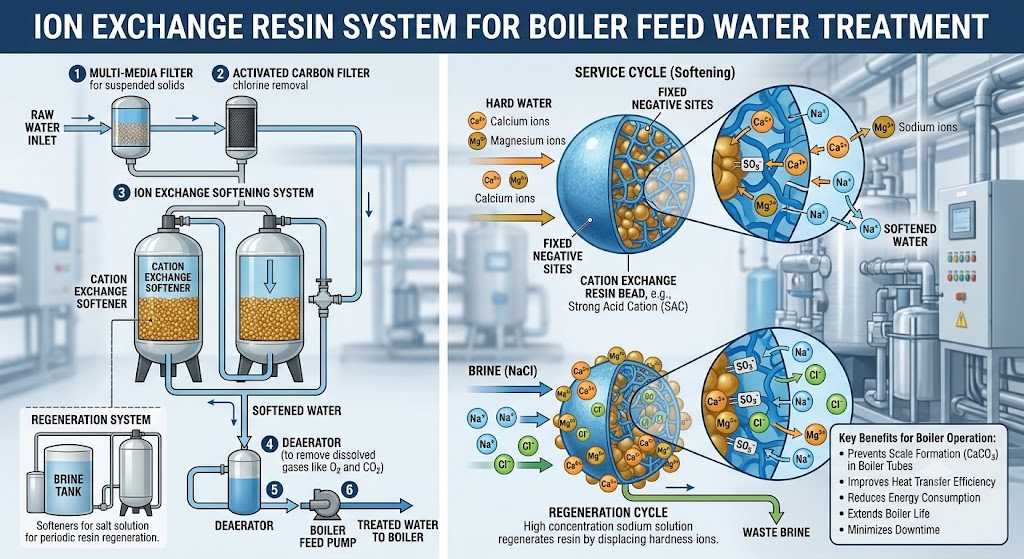
Introduction to Boiler Feed Water Treatment
Boiler Feed Water Treatment is the process of conditioning the water that enters a boiler so that it is free of the dissolved minerals, gases, and impurities that damage equipment and waste energy.
Raw water—whether from a borewell, municipal supply, or surface source—is never pure. It carries calcium, magnesium, sodium, chlorides, sulphates, silica, and dissolved gases that wreak havoc inside a high-pressure, high-temperature boiler.
Ion Exchange Resin for Boiler Feed Water Treatment removes these troublesome ions before they ever reach the boiler drum. The result is cleaner steam, lower fuel consumption, and longer equipment life.
For any plant running steam boilers, this is not an optional upgrade—it is essential infrastructure. Industry bodies such as the American Society of Mechanical Engineers (ASME) publish strict feed water guidelines precisely because poor water quality is one of the leading causes of boiler failure worldwide.
What is Ion Exchange Resin?
Ion Exchange Resin is a synthetic polymer in the form of tiny porous beads, each loaded with active chemical sites that swap unwanted ions in water for harmless ones.
Picture millions of microscopic beads, each about 0.3 to 1.2 mm in diameter, packed into a pressure vessel. As water flows through, the resin grabs hardness-causing and corrosive ions and releases acceptable ones in exchange.
This simple but powerful chemistry is the engine behind every Demineralization Plant and water softener used in industry today. There are three main families of resin used in boiler water treatment.
Cation Exchange Resin
Cation Exchange Resin removes positively charged ions such as calcium (Ca²⁺), magnesium (Mg²⁺), and sodium (Na⁺).
These are the ions responsible for hardness and scaling. In a softener, a Water Softening Resin swaps calcium and magnesium for sodium. In a DM Plant, it swaps them for hydrogen ions (H⁺), producing acidic, mineral-free water.
Anion Exchange Resin
Anion Exchange Resin removes negatively charged ions such as chlorides (Cl⁻), sulphates (SO₄²⁻), nitrates, silica, and carbonates.
Working in tandem with cation resin, it strips out the remaining dissolved salts to produce High Purity Water suitable for high-pressure boilers.
Mixed Bed Resin
Mixed Bed Resin combines cation and anion resins in a single vessel for a final polishing step.
This intimate mix acts like thousands of tiny demineralizers stacked together, producing ultra-pure, near-zero-conductivity water. It is the standard for power plants and electronics manufacturing where High Purity Water is non-negotiable.
Why Boiler Feed Water Requires Treatment
Untreated water is one of the most expensive mistakes a plant can make. Here is what happens when raw water enters a boiler unchecked.
- Hardness Problems
Hardness from calcium and magnesium is the primary enemy of boilers.
When hard water is heated, these minerals precipitate out and stick to internal surfaces. This is why Water Softening Resin and demineralization are the first line of defense in any Industrial Water Treatment program.
- Scaling Issues
Scale is a rock-hard insulating layer of mineral deposits that forms on boiler tubes and heat exchange surfaces.
Even a thin scale layer dramatically reduces performance. According to the U.S. Department of Energy, scale just 1 mm thick can increase fuel consumption by roughly 5–8%, and thicker deposits push that figure far higher.
- Corrosion Risks
Dissolved oxygen and carbon dioxide, along with low pH, cause pitting and corrosion that eats through boiler metal.
Corrosion not only shortens equipment life but can lead to dangerous, costly tube failures and unplanned shutdowns.
- Reduced Heat Transfer Efficiency
Scale and deposits act as insulation, forcing the boiler to burn more fuel to deliver the same amount of steam.
A clean boiler transfers heat efficiently; a fouled one wastes energy on every single cycle, quietly draining profits.
<h2 id=”how-it-works”>How Ion Exchange Resin for Boiler Feed Water Treatment Works</h2>
Ion Exchange Resin for Boiler Feed Water Treatment works by trading harmful ions in the water for harmless ones at the surface of the resin beads.
- Ion Exchange Process
The Ion Exchange Process is a reversible chemical reaction. As water passes through the resin bed, dissolved ions in the water are attracted to the active sites on the beads and held there, while the resin releases its own ions in exchange.
Once the resin is “exhausted”—saturated with the ions it has captured—it is regenerated and returned to service.
- Demineralization Process
In a Demineralization Plant, water first passes through cation resin (removing positive ions and forming weak acids) and then through anion resin (removing negative ions).
The combined effect strips out virtually all dissolved salts, producing Deionization Resin–grade water with extremely low conductivity—ideal for medium and high-pressure boilers.
- Water Softening Process
Softening is the simplest application. Strong Acid Cation resin in the sodium form exchanges hardness ions (Ca²⁺ and Mg²⁺) for sodium ions.
The water leaves soft and scale-free, perfect for low-pressure boilers and pre-treatment ahead of a full DM Plant Resin system.
Types of Ion Exchange Resins Used in Boiler Feed Water Treatment
Choosing the right resin depends on your raw water chemistry, boiler pressure, and purity requirements. Here are the four workhorse resins.
- Strong Acid Cation Resin
Strong Acid Cation (SAC) resin uses sulfonic acid groups and works across the entire pH range.
It removes all cations and is the standard choice for the first stage of most DM plants and for water softening.
- Weak Acid Cation Resin
Weak Acid Cation (WAC) resin uses carboxylic acid groups and targets hardness linked to alkalinity.
It regenerates with far less acid than SAC resin, making it highly efficient and economical for waters with high alkalinity.
- Strong Base Anion Resin
Strong Base Anion (SBA) resin removes all anions, including weakly ionized ones like silica and carbon dioxide.
It is essential where ultra-low silica is required, such as in high-pressure power plant boilers.
- Weak Base Anion Resin
Weak Base Anion (WBA) resin removes strong-acid anions like chlorides, sulphates, and nitrates.
It regenerates very efficiently and is often paired with SBA resin to cut chemical costs in larger systems.
- Resin Comparison Table
Resin Type | Functional Group | Removes | Regenerant | Best For |
Strong Acid Cation (SAC) | Sulfonic acid | All cations | HCl / H₂SO₄ | Softening, DM first stage |
Weak Acid Cation (WAC) | Carboxylic acid | Hardness with alkalinity | HCl / H₂SO₄ | High-alkalinity water |
Strong Base Anion (SBA) | Quaternary ammonium | All anions + silica | NaOH | High-purity, low-silica |
Weak Base Anion (WBA) | Tertiary amine | Strong-acid anions | NaOH / soda ash | Economical bulk removal |
Mixed Bed | SAC + SBA combined | All ions | HCl + NaOH | Final polishing, High Purity Water |
Top 10 Benefits of Ion Exchange Resin for Boiler Feed Water Treatment
Investing in the right resin system delivers measurable returns. Here are the top ten benefits.
- Improved Boiler Efficiency
Clean feed water means clean heat-transfer surfaces, so your boiler delivers more steam from less fuel. Efficiency gains of several percentage points are common after installing a proper Water Purification System.
- Reduced Scaling
By removing hardness ions at the source, Ion Exchange Resin for Boiler Feed Water Treatment virtually eliminates scale formation on tubes and drums.
- Lower Maintenance Costs
No scale and no corrosion means fewer acid cleanings, fewer tube replacements, and dramatically lower annual maintenance spend.
- Extended Equipment Life
Protecting metal surfaces from scale and corrosion can add years—sometimes decades—to the operational life of your boiler and ancillary equipment.
- Better Steam Quality
Demineralized feed water produces clean, dry steam with minimal carryover, protecting turbines and process equipment downstream.
- Reduced Downtime
Fewer scale-related failures and emergency cleanings translate directly into more uptime and reliable, uninterrupted production.
- Improved Energy Efficiency
Because heat transfers freely through clean surfaces, you burn less fuel for the same output—a direct, ongoing saving on energy bills.
- Consistent Water Quality
A well-designed ion exchange system delivers the same High Purity Water output day after day, removing variability from your process.
- Environmental Benefits
Lower fuel consumption means lower emissions. Efficient Industrial Water Purification also reduces blowdown and water waste, supporting your sustainability goals.
- Cost Savings
Add it all up—fuel, maintenance, equipment life, and downtime—and the total cost savings from quality Water Treatment Solutions are substantial and rapid.
Applications of Ion Exchange Resin in Industries
Ion exchange technology is used across virtually every steam-using and high-purity-water industry:
- Power Plants – High-pressure boilers demand ultra-pure, low-silica feed water for turbine protection.
- Pharmaceutical Industry – Requires purified and High Purity Water for production, cleaning, and steam generation.
- Food and Beverage Industry – Needs scale-free boilers and consistent water quality for safe, hygienic processing.
- Chemical Processing – Relies on demineralized water for reactions, cooling, and steam systems.
- Textile Industry – Uses soft, treated water for dyeing, finishing, and boiler operation to avoid stains and scale.
- Automotive Industry – Depends on treated water for painting, rinsing, and process steam.
- Electronics Manufacturing – Uses Mixed Bed Resin to produce ultra-pure water for semiconductor and component cleaning.
Signs Your Boiler Feed Water System Needs Resin Replacement
Resin does not last forever. Watch for these warning signs that it is time to replace or recharge your media:
- Treated water conductivity or hardness is rising despite regular regeneration.
- Output water quality slips below your required specification.
- Regeneration cycles are needed far more frequently than before.
- The resin bed shows fouling, channeling, or discoloration.
- You notice broken or fragmented resin beads in the bed.
- Pressure drop across the vessel has increased noticeably.
- The resin is simply old—most resins last 5–10 years depending on conditions.
If you are seeing several of these, it is time to talk to a specialist about fresh high-quality ion exchange resins.
Resin Regeneration Process
Regeneration restores exhausted resin to its active form so it can be reused, making ion exchange both sustainable and economical.
Cation Resin Regeneration
Cation resin is regenerated with a strong acid—typically hydrochloric acid (HCl) or sulphuric acid (H₂SO₄).
The typical sequence is: backwash to loosen the bed, slow injection of the acid regenerant, a slow rinse, and finally a fast rinse to flush out excess chemicals before returning the unit to service.
Anion Resin Regeneration
Anion resin is regenerated with a strong base—usually caustic soda (sodium hydroxide, NaOH).
The same backwash, regenerant injection, slow rinse, and fast rinse steps apply. Proper Resin Regeneration is critical: under-regeneration causes early breakthrough, while over-regeneration wastes chemicals and money.
<h2 id=”maintenance”>Maintenance Tips for Ion Exchange Resin Systems</h2>
Follow these practical steps to keep your ion exchange system running at peak performance:
- Monitor output water quality daily – Track conductivity, pH, and hardness to catch problems early.
- Maintain regeneration schedules – Regenerate on time using the correct dosage and concentration of chemicals.
- Check the resin bed regularly – Inspect for fouling, channeling, and bead breakdown during routine shutdowns.
- Ensure proper pre-treatment – Protect resin from chlorine, iron, and suspended solids with adequate filtration upstream.
- Control flow rates – Operate within the manufacturer’s recommended flow range to avoid channeling and damage.
- Test resin capacity periodically – Send samples for analysis to confirm the resin still meets capacity targets.
- Replace resin proactively – Plan replacement before performance falls below specification to avoid unplanned downtime.
- Keep detailed logs – Record every regeneration, water test, and maintenance action for trend analysis.
Why Choose Hanumanta Watertech for Ion Exchange Resin Solutions
When your boiler—and your production—depend on water quality, you need a partner who understands the chemistry and the engineering. Here is why leading plants trust us for industrial water treatment solutions:
- Industrial Water Treatment Expertise – Decades of combined experience designing and servicing DM plants, softeners, and complete Water Purification Systems.
- High-Quality Resins – We supply premium cation, anion, and Mixed Bed Resin from trusted manufacturers for consistent, reliable performance.
- Technical Support – Our engineers help you select, size, install, and troubleshoot your system at every stage.
- Customized Solutions – We design systems around your specific raw water chemistry, boiler pressure, and purity requirements.
- Competitive Pricing – Premium quality and dependable service at prices that protect your operating budget.
Conclusion
Ion Exchange Resin for Boiler Feed Water Treatment is not just a technical detail—it is one of the smartest investments you can make in your plant’s efficiency, reliability, and longevity. From preventing scale and corrosion to slashing fuel costs and downtime, the right resin system pays for itself many times over.
Whether you need a complete Demineralization Plant, a water softener, or premium replacement resins, the key is partnering with experts who understand both the chemistry and your operation.
Contact Hanumanta Watertech
For premium-quality IONIC-RESIN™ and industrial water treatment solutions, contact Hanumanta Watertech today.
Contact Details
- Company Name: Hanumanta Watertech
- Location: Gujarat, India
- Mo
+91 81283 74466
+91 75675 51100 - Email: hanumantawatertech@gmail.com
- Website: https://hanumantawatertech.com
Frequently Asked Questions
1. What is Ion Exchange Resin for Boiler Feed Water Treatment?
It is a synthetic polymer media that removes hardness, dissolved salts, and corrosive ions from water before it enters a boiler, preventing scaling and corrosion while producing clean, efficient steam.
2. How does Ion Exchange Resin for Boiler Feed Water Treatment prevent scaling?
The resin captures calcium, magnesium, and other scale-forming ions and exchanges them for harmless ions, so no mineral deposits form on the heated boiler surfaces.
3. What is the difference between Cation Exchange Resin and Anion Exchange Resin?
Cation Exchange Resin removes positively charged ions like calcium and magnesium, while Anion Exchange Resin removes negatively charged ions like chlorides, sulphates, and silica.
4. Is a Demineralization Plant better than a water softener for boilers?
For medium and high-pressure boilers, a Demineralization Plant is far superior because it removes nearly all dissolved salts. Water Softening Resin alone only removes hardness and suits low-pressure boilers.
5. Can ion exchange improve boiler energy efficiency?
Yes. By eliminating scale, Ion Exchange Resin for Boiler Feed Water Treatment keeps heat-transfer surfaces clean, reducing fuel consumption and improving overall Boiler Water Treatment efficiency.